
The decision guide · Updated 2026
How Safe Is Gastric Sleeve Surgery in Turkey?
Asking how safe is gastric sleeve surgery in Turkey is the right first question — and it has an honest answer: as safe as leading Western centres, if five verifiable conditions are met, and genuinely dangerous when they are not. This guide shows you exactly how to tell the difference before you book.

The short answer
Is Gastric Sleeve Surgery Safe in Turkey? Yes — Under Five Conditions
Gastric sleeve surgery in Turkey is safe when it is performed by an experienced, verifiable surgeon in an internationally accredited hospital, with full pre-operative screening, in-hospital recovery until discharge, and structured aftercare that continues once you are home. Where those five conditions hold, outcomes match leading Western European and US centres. Where they do not — unaudited clinics, hotel-based recovery, aftercare that ends at the airport — the risk profile changes completely. In other words: the country is not the risk factor; the clinic is.
0:21 · tap play for sound
Video · The surgeon's answer in 21 seconds
Is it safe to go to Turkey for a gastric sleeve?
It can be. Safety depends less on the country than on where you are operated on and by whom. Four things to check before you book:
- A JCI- and TEMOS-accredited hospital
- An experienced surgeon: 5,000+ operations
- Four nights in hospital until discharge, not a hotel
- 12 months of aftercare at home by video call and WhatsApp
Transcript and checklist: is it safe to go to Turkey for a gastric sleeve
That distinction is missing from most of what UK patients read. Domestic warnings treat Turkey as one uniform destination, and budget clinics treat safety as a given. Neither is true, and the honest answer to how safe is gastric sleeve surgery in Turkey depends entirely on which of the two systems you walk into. «Is it safe to have gastric sleeve in Turkey?» is among the most-typed questions on google.co.uk — the rest of this page turns that question into a checklist you can verify yourself.
The same caution applies to procedures sold as gentler than surgery: an endoscopic sleeve avoids incisions, but the stitches often loosen. See endoscopic sleeve gastroplasty failure.
The checklist
What Actually Determines Safe Gastric Sleeve Surgery — 6 Things to Verify
None of the items below requires trust. Every one is checkable from the UK, before you pay anyone a penny — accreditation registers are public, IFSO membership is public, and any serious clinic will answer the rest in writing. Safe gastric sleeve surgery is not a promise a clinic makes; it is a set of conditions you confirm.

At our clinic these six read as follows: operations at a JCI- and TEMOS-accredited hospital in İzmir; every procedure performed personally by an IFSO-member surgeon with more than 5,000 bariatric operations; gastric sleeve surgery in Turkey patients stay four nights in hospital until discharge — no hotel transfer; cardiology, chest and anaesthesia clearance before every operation; and 12 months of follow-up by video call and WhatsApp after you fly home.
How common, really?
Gastric Sleeve Complications in Turkey: What to Actually Watch For
Half of the how safe is gastric sleeve surgery in Turkey question is really a question about complications. Every surgical consent form lists frightening possibilities; what patients actually need is frequencies. In accredited centres, the gastric sleeve complications Turkey records are the same as anywhere else in the developed world — and each of the serious ones has a specific defence built into a proper protocol:
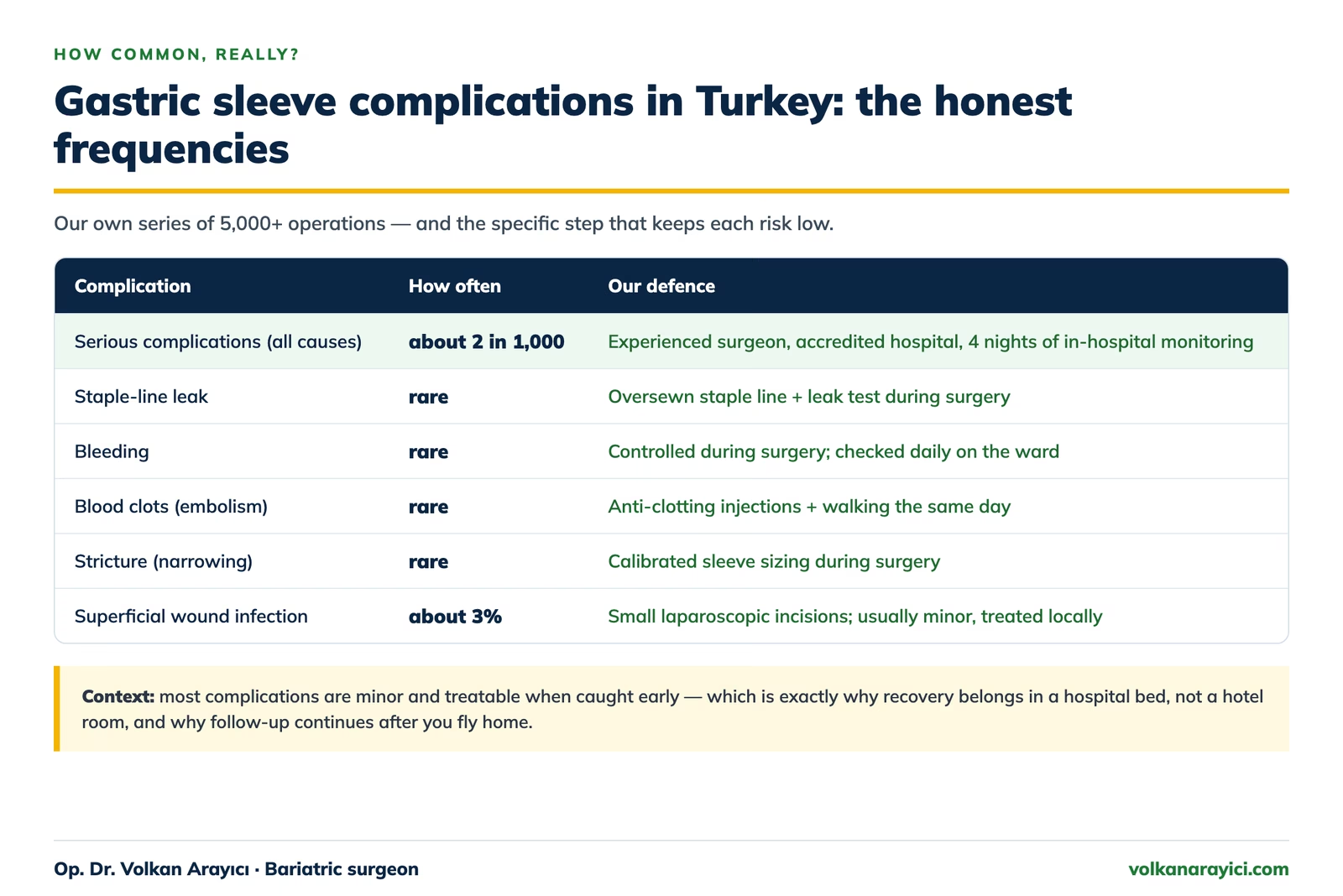
The one to understand best is the staple-line leak — rare, but the complication behind most serious outcomes when it is caught late. In our protocol the staple line is oversewn with an inverting suture and tested during the operation itself, and the four-night hospital stay exists precisely so that early gastric sleeve leak symptoms are spotted by clinical staff, not by a hotel receptionist. Reflux deserves honesty too: it is the sleeve's known long-term weakness, which is why patients with significant reflux are steered towards a bypass before surgery, not consoled after it.
Red flags
Signs a Clinic May Not Prioritise Safety
The gastric sleeve surgery safety Turkey debate in the UK press is really a debate about one clinic segment. The tragic cases in the headlines almost never involve one unlucky complication in a good hospital — they involve a pattern of shortcuts that was visible before booking. These are the six warning signs worth screening every offer against:

The simplest test of all: ask, in writing, where you will sleep on nights two and three after surgery. "Hospital, until the surgeon discharges you" is the answer safety sounds like. Anything involving a hotel is the single clearest signal to keep looking.
The plan B question
What Happens If a Complication Occurs?
This is the question that separates a hospital from a package. In our setting the answer is concrete: you are already in a fully equipped hospital with intensive-care capability and the operating surgeon on site — a complication is identified and treated in the same building, usually within hours, and at no additional cost. Compare that with the budget model, where a patient in a hotel room must first recognise the emergency themselves, then find their way back to a facility that may not have an ICU at all. Same complication, two completely different outcomes — that gap, not the operation, is what the UK warnings are really about. It is also why any answer to how safe is gastric sleeve surgery in Turkey that skips the complication plan is incomplete.
Safety first · personal reply within 24 hours
Is surgery in Turkey safe for your case? Ask the surgeon before you book
Send me your height, weight, age and any conditions you are treated for. I review every request myself and tell you honestly whether a gastric sleeve in Turkey is a safe option for you — or whether something should be checked or treated first.
- Personal reply from Op. Dr. Volkan Arayıcı, not a sales coordinator
- A clear answer on sleeve or bypass for your history
- No deposit, no booking fee, no obligation
Prefer WhatsApp? Write to me on +90 532 466 67 67 — I answer my messages myself.
The part most clinics skip
Back in the UK: Aftercare, Your GP and the Follow-Up Gap
Ask NHS doctors what worries them about surgery abroad and the answer is rarely the operation — it is what happens after the flight home. A patient lands with fresh anatomy, no local surgeon, and a GP who was never involved in the decision. That gap is real, and it is exactly the part of bariatric surgery safety in Turkey that a serious clinic must solve rather than shrug at.
Our model: 12 months of structured follow-up by video call and WhatsApp, with the surgeon himself answering — diet progression, blood-test timing, symptom checks, and rapid review of anything that feels wrong. You also fly home with a full discharge report (operation notes, medication plan, follow-up schedule) written for your GP, so your UK care continues informed rather than blind. Aftercare is not a courtesy extra; it is the sixth safety condition in the how safe is gastric sleeve surgery in Turkey checklist, and you should refuse any offer that leaves it out. What patients say about aftercare months later is quoted word for word, with names and dates, on our gastric sleeve Turkey reviews page.
What UK surgeons warn about
What UK Surgeons and the UK Government Advise — and How to Check Any Clinic Against It
In September 2023 the British Obesity & Metabolic Specialist Society (BOMSS) advised UK residents to be cautious about bariatric surgery abroad. The UK Foreign Office's travel advice for Turkey, updated in October 2026, says it is aware of seven British nationals who died in Turkey in 2025 following medical procedures — a figure covering all treatments, including cosmetic and dental — and asks travellers to discuss their plans with a UK doctor and to do their own research rather than rely on a clinic's brochure.
Both warnings are fair, and we would rather you read them here than discover them later. BOMSS lists seven specific concerns. Below is each one, the question it should make you ask any clinic, and our own answer — so you can check it rather than take it on trust.
| BOMSS concern | Ask any clinic | Our answer |
|---|---|---|
| Inadequate assessment before surgery | Who examines me before the operation — and can they cancel it? | On the morning of day 2: abdominal ultrasound, echocardiogram, cardiology, chest and anaesthesia review. If anything is not right, the operation does not go ahead. |
| Poor choice of procedure | Who decides between sleeve and bypass, and on what basis? | The operating surgeon, from your history — reflux, diabetes, weight. Significant reflux points to a bypass; our gastric sleeve vs gastric bypass guide explains the trade-offs. |
| A different procedure than expected, or details unknown | Will I receive a written record of exactly what was done? | You leave with an English discharge report: the operation performed, findings, medication and the follow-up plan, written for your GP. |
| Unknown quality and safety of surgery | Who operates — by name — and how many operations has he done? | Op. Dr. Volkan Arayıcı operates personally: more than 5,000 bariatric operations, in a JCI- and TEMOS-accredited hospital in İzmir. |
| Long-distance travel straight after surgery (blood clots) | How many nights am I in hospital before I fly? | Four nights in hospital until discharge — never a hotel — and you fly home on day 5, walking from the day of the operation. |
| Little or no follow-up after you return | Who looks after me once I am home, and for how long? | 12 months of follow-up by video call and WhatsApp with the surgeon, including your blood-test schedule; after that, regular checks with your GP. |
| No access to expert help if a late problem appears | Who do I contact at month three if something feels wrong? | The surgeon directly on WhatsApp for advice; in an emergency, your nearest A&E with the discharge report in hand. |
BOMSS believes bariatric care is best delivered in the UK, and if you can access timely NHS or private UK surgery that is a reasonable choice. If you decide on gastric sleeve surgery in Turkey, treat the seven questions above as the minimum standard — and walk away from any clinic that cannot answer them in writing. Sources: BOMSS statement on going abroad for weight loss surgery (6 September 2023) · FCDO Turkey travel advice — health (updated October 2026).
Each of these BOMSS concerns is answered point by point – with a printable GP letter template and a blood-test plan – in our weight loss surgery abroad checklist.
The first two weeks
Flying Home After a Gastric Sleeve: Blood Clots, Pain and Recovery
Is it safe to fly home after a gastric sleeve in Turkey?
The risk of a blood clot is highest in the first weeks after any major operation, and a long flight adds to it. That is one reason we keep patients in hospital for four nights and schedule the flight for day 5 rather than day 2 or 3. On the flight itself: walk the aisle every hour, keep taking small sips of water — our guide to water consumption after gastric sleeve explains why sipping matters — avoid alcohol and sleeping tablets, and wear compression stockings if your team advises them. A swollen or painful calf, sudden breathlessness or chest pain after you land is an emergency: call 999 or go to A&E.
How long will I be in pain after a gastric sleeve?
With keyhole surgery most patients describe the first two to three days as the hardest: soreness around the small incisions and a typical shoulder-tip ache from the gas used during the operation, both treated with pain relief in hospital and eased by walking. By discharge on day 5 most people move around independently, and by about two weeks most feel close to normal for desk work. Pain that gets worse instead of better, a fever, or vomiting that does not settle is not normal recovery — contact the surgeon the same day.
What they don't tell you
The Honest Downsides — Even When Everything Goes Right
"Gastric sleeve surgery ruined my life" and "what they don't tell you about gastric sleeve" are real UK searches, and pretending those feelings don't exist would make this page marketing. So, plainly: even a perfectly executed sleeve is irreversible; portion sizes change permanently; vitamins are needed for about nine months; alcohol hits harder and faster — our guide to alcohol consumption after a gastric sleeve operation explains why; fizzy drinks and grazing on sweets can quietly undo the result; some patients develop reflux; and significant weight loss can mean loose skin, which body contouring after weight loss can address once the weight is stable. None of this is a complication — it is the deal.
Most patients accept that deal knowingly and would sign again — but the right place to weigh it is before surgery. The full list, stated as bluntly as here, is on our disadvantages of gastric sleeve page. A clinic that only shows you before-and-after photos is not informing you; it is selling to you.
The wider picture
Is Weight Loss Surgery in Turkey Safe Beyond the Sleeve?
The same five conditions govern every procedure. So if you are asking is weight loss surgery in Turkey safe as a whole — balloon, sleeve, bypass or revision — the answer follows the clinic, not the operation. The checklist above transfers unchanged.
Is gastric bypass surgery safe in Turkey?
Yes, under the same conditions — with one honest nuance: a gastric bypass surgery is technically more complex than a sleeve, involves intestinal connections, and carries a slightly higher complication rate. That is precisely why the "gastric bypass surgery safe in Turkey" question should raise the bar on surgeon experience: it is an operation to have where bypasses and revisions are routine — several hundred per year — not occasional. In experienced accredited centres, bypass outcomes in Turkey match Western benchmarks, and for reflux or diabetes-dominant patients the bypass is often the safer long-term choice despite the marginally higher surgical figure.
As for the raw statistics — 30-day mortality, year-by-year trends, and how the numbers compare with everyday operations like gallbladder removal — we keep all of that on a dedicated data page: gastric sleeve death rate Turkey. The one-line version: about 0.1% in accredited hospitals, and zero in our own 5,000+ operations.
Who is answering
Judge Us by the Same Checklist
Every clinic answers how safe is gastric sleeve surgery in Turkey the same way: "very". So don't ask for the answer — ask for the evidence. This guide was written by Op. Dr. Volkan Arayıcı, IFSO-member bariatric surgeon in İzmir, and the fairest way to use it is to hold our own clinic to every line of it. Accreditation: JCI and TEMOS, verifiable. Surgeon: named, with 5,000+ personal operations and zero mortality, background on the about Dr. Volkan Arayıcı page. Recovery: four nights in hospital, never a hotel. Screening: three specialist clearances before every operation. Aftercare: 12 months, answered personally. Then compare any other offer — including cheaper ones — against the same six lines. If you want the same test applied to clinic marketing claims, our guide to which is the best gastric sleeve clinic shows how to read between the lines.
Send us the offer you are considering — we will tell you honestly which questions to ask before accepting it.
WhatsApp: +90 532 466 67 67FAQ
How Safe Is Gastric Sleeve Surgery in Turkey? — Frequently Asked Questions
Is it safe to have gastric sleeve in Turkey?
Yes — the honest answer to how safe is gastric sleeve surgery in Turkey is "as safe as the clinic you choose": an internationally accredited hospital, a named IFSO-member surgeon, full pre-operative screening, in-hospital recovery and structured aftercare. Outcomes in that setting match Western centres. Without those conditions, the risk changes completely: verify the checklist on this page before booking anywhere.
What is the mortality rate for gastric sleeve surgery in Turkey?
Approximately 0.1% within 30 days in accredited hospitals — about 1 in 1,000 patients, below the ~0.2% global average. Our own record is zero deaths in more than 5,000 operations. The full statistics, year-by-year trends and comparisons are on our gastric sleeve death rate Turkey page.
How common are gastric sleeve complications?
Serious complications are uncommon: in our own series about 2 in 1,000 operations. A superficial wound infection occurs in about 3% and is usually minor. The most frequent long-term issue is reflux (10–20%), which is why reflux-prone patients are advised towards a bypass before surgery rather than after.
Which country is best for gastric sleeve surgery?
The honest answer: no country is "best" — accredited hospitals with high-volume surgeons deliver equivalent safety in Turkey, the UK, Germany or the US. Turkey's advantage is cost and speed at equal clinical standards, provided you choose an accredited centre; its risk is the unaudited budget segment that exists alongside them.
Is gastric bypass surgery safe in Turkey?
Yes, under the same conditions as the sleeve — accreditation, an experienced surgeon and proper aftercare. The bypass is technically more complex, so surgeon volume matters even more; in experienced centres its outcomes match Western benchmarks, and for reflux or diabetes-dominant patients it is often the better long-term choice.
What can you never do again after a gastric sleeve?
Very little is truly forbidden, but some things change for life: large portions are gone, vitamins are needed for about nine months, alcohol hits much harder, and fizzy drinks plus constant sugary snacking can undo the result. The operation is also irreversible — the full honest list is on our disadvantages page.
What happens if I have a problem after I'm back in the UK?
You are not on your own. Follow-up continues for 12 months by video call and WhatsApp with the surgeon himself, and you travel home with a full discharge report written for your GP. Urgent concerns are reviewed the same day, and we coordinate with UK clinicians when hands-on care is needed.
Is weight loss surgery in Turkey safe overall?
Yes, with the same caveat as the sleeve-specific question — bariatric surgery safety in Turkey tracks the clinic, not the country: accredited hospitals with experienced teams report outcomes equal to Western Europe, while the unaudited budget segment is where the well-publicised problems cluster. Apply the six-point checklist on this page and the distinction becomes easy to see.
Is gastric sleeve considered a high-risk surgery?
It is major abdominal surgery, but among weight loss operations it is one of the lower-risk procedures. In experienced, accredited centres serious complications are uncommon — in our own series about 2 in 1,000 operations — and in the largest international registry (447,326 sleeves) the 30-day mortality was 0.07%. The risk rises with poor patient selection, inexperienced surgeons and early discharge to a hotel — which is why the checklist on this page matters more than the country.
How long will I be in pain after gastric sleeve surgery?
For most patients the first two to three days are the most uncomfortable — wound soreness and shoulder-tip pain from the gas used in keyhole surgery — and both are managed with pain relief in hospital. By discharge on day 5 most move around independently, and within about two weeks most feel close to normal for desk work. Pain that is getting worse, fever or persistent vomiting needs a same-day call to the surgeon.
Is it safe to fly home after gastric sleeve surgery in Turkey?
Yes, when the flight is not rushed. Our patients stay four nights in hospital and fly on day 5. On board, walk every hour, keep sipping water, avoid alcohol and sleeping tablets, and use compression stockings if advised. Calf swelling, sudden breathlessness or chest pain after the flight is an emergency — call 999.
What does the UK government say about weight loss surgery in Turkey?
The Foreign Office's Turkey travel advice (updated October 2026) reports seven British nationals who died in Turkey in 2025 following medical procedures of all kinds, and advises discussing plans with a UK doctor and researching beyond clinic marketing. The surgeons' society BOMSS advises caution and lists seven concerns — each is answered, with the question to ask any clinic, in the UK guidance section above.
Still unsure? · written answer from the surgeon
Send your safety question — and get a written answer
Worried about a specific risk, a condition you have, or an offer from another clinic? Write it down. You will get a written reply from Op. Dr. Volkan Arayıcı that you can show your GP.
- Honest answer — including when surgery is not the right step
- Four nights in hospital, 12 months of aftercare — in writing
- No deposit, no obligation
Prefer WhatsApp? Write to me on +90 532 466 67 67.
Op. Dr. Volkan Arayıcı
Specialist in Bariatric & Metabolic Surgery · Izmir, Turkey
This article was written and medically reviewed by Op. Dr. Volkan Arayıcı. Dr. Arayıcı has been exclusively specialising in bariatric surgery since 2014 and has performed over 5,000 procedures at a JCI- and TEMOS-accredited hospital in Izmir.
✍ Published: February 24, 2024 · 🔄 Updated: November 12, 2026 · About the author →
