
The real numbers · Updated 2026
Gastric Sleeve Death Rate Turkey: What the Real Numbers Show
Searching for the gastric sleeve death rate Turkey statistics is one of the most responsible things you can do before committing to surgery — and it deserves one consistent, literature-backed answer instead of a scattered set of numbers. Here it is: about 0.1% in accredited hospitals, roughly 1 in 1,000 patients.

The direct answer
Gastric Sleeve Death Rate Turkey vs the Global Average
The gastric sleeve death rate Turkey records in JCI- and TEMOS-accredited hospitals is approximately 0.1% within 30 days of surgery — about 1 in 1,000 patients. That sits below the pooled global average of roughly 0.2% for all centres worldwide, and in line with the leading bariatric units of Western Europe and the United States. Large registry studies of laparoscopic sleeve gastrectomy report figures as low as 0.05% in high-volume centres — which is precisely the point: the number tracks the hospital and the surgeon, not the country on the map.
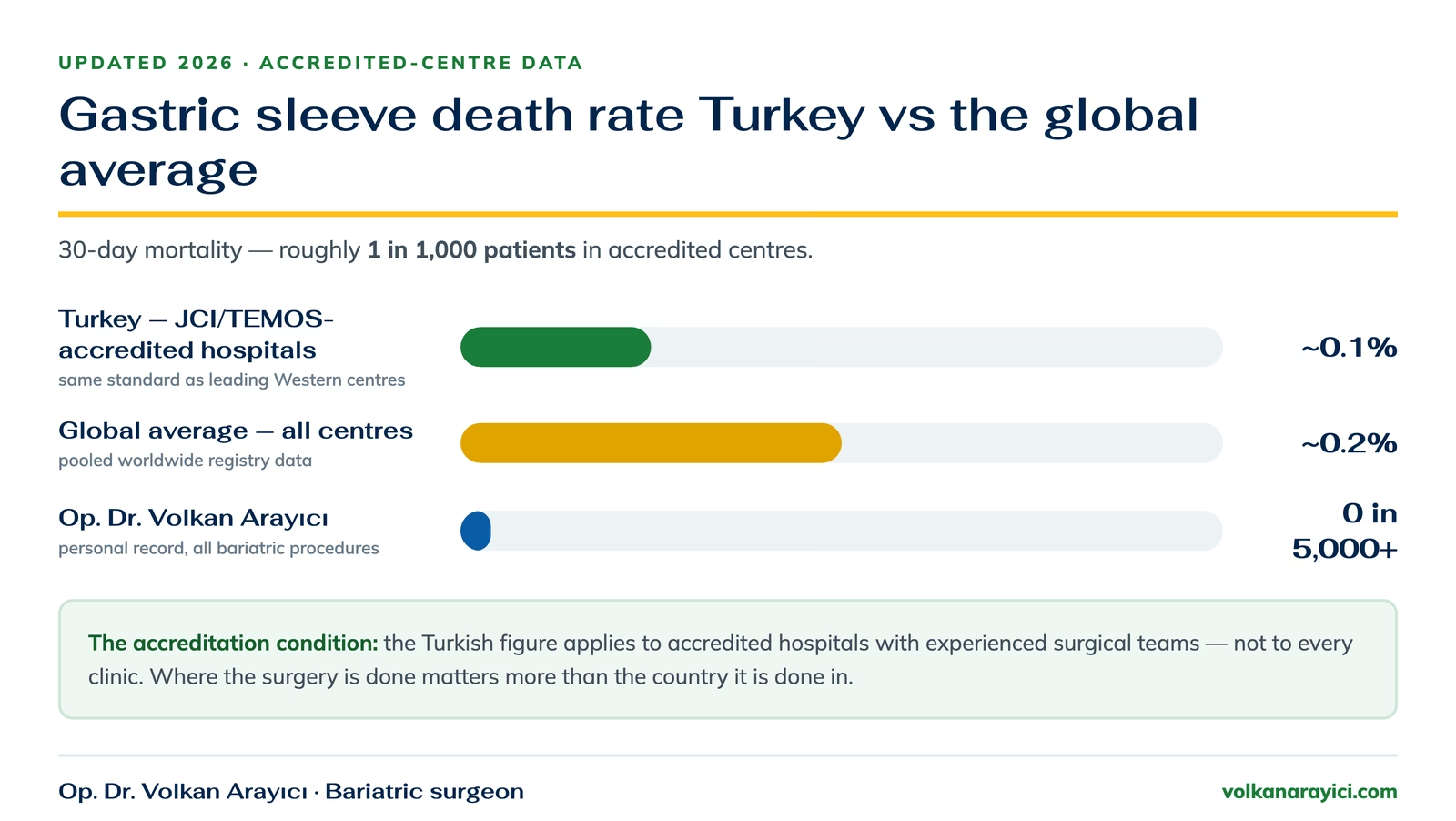
Why you see different numbers online: some sources count deaths within 30 days, others within 90 days or only during the hospital stay; some pool every clinic, others only audited centres. When UK patients search for the gastric sleeve Turkey death rate, the honest, comparable figure — 30-day mortality in accredited hospitals — is the ~0.1% above. Any clinic quoting "0% risk" for surgery in general is marketing, not medicine.
2022 · 2023 · 2026
Has the Gastric Sleeve Death Rate Changed in Recent Years?
Short answer: it keeps improving. The gastric sleeve death rate has fallen steadily over two decades as stapling technology, anaesthesia and surgeon volumes matured — worldwide bariatric mortality dropped roughly ten-fold since the early 2000s. Between 2022, 2023 and today the figure has been stable at the low level above; no credible registry shows it rising. So if you are comparing "gastric sleeve death rate 2023" against 2026, you are looking at the same reassuring picture — the year matters far less than the accreditation of the hospital you choose.
The same logic applies to the wider bariatric surgery death rate: across all procedure types it averages around 0.1–0.2% in experienced centres, with the sleeve at the safer end of the range because it does not reroute the intestine. Put differently, the gastric sleeve death rate Turkey publishes from its accredited hospitals today would have been considered exceptional anywhere in the world fifteen years ago — and it is now simply the standard of care.
Perspective
Gastric Sleeve Mortality Rate in Context: Surgery vs the Sofa
Numbers only mean something next to other numbers. Taken alone, the gastric sleeve death rate Turkey records can still sound frightening — any number attached to the word "death" does. But the gastric sleeve mortality rate of ~0.1% is in the same band as gallbladder removal and below hip replacement — two operations nobody describes as extreme. The riskiest option in this table is the one that feels safest: doing nothing about severe obesity.
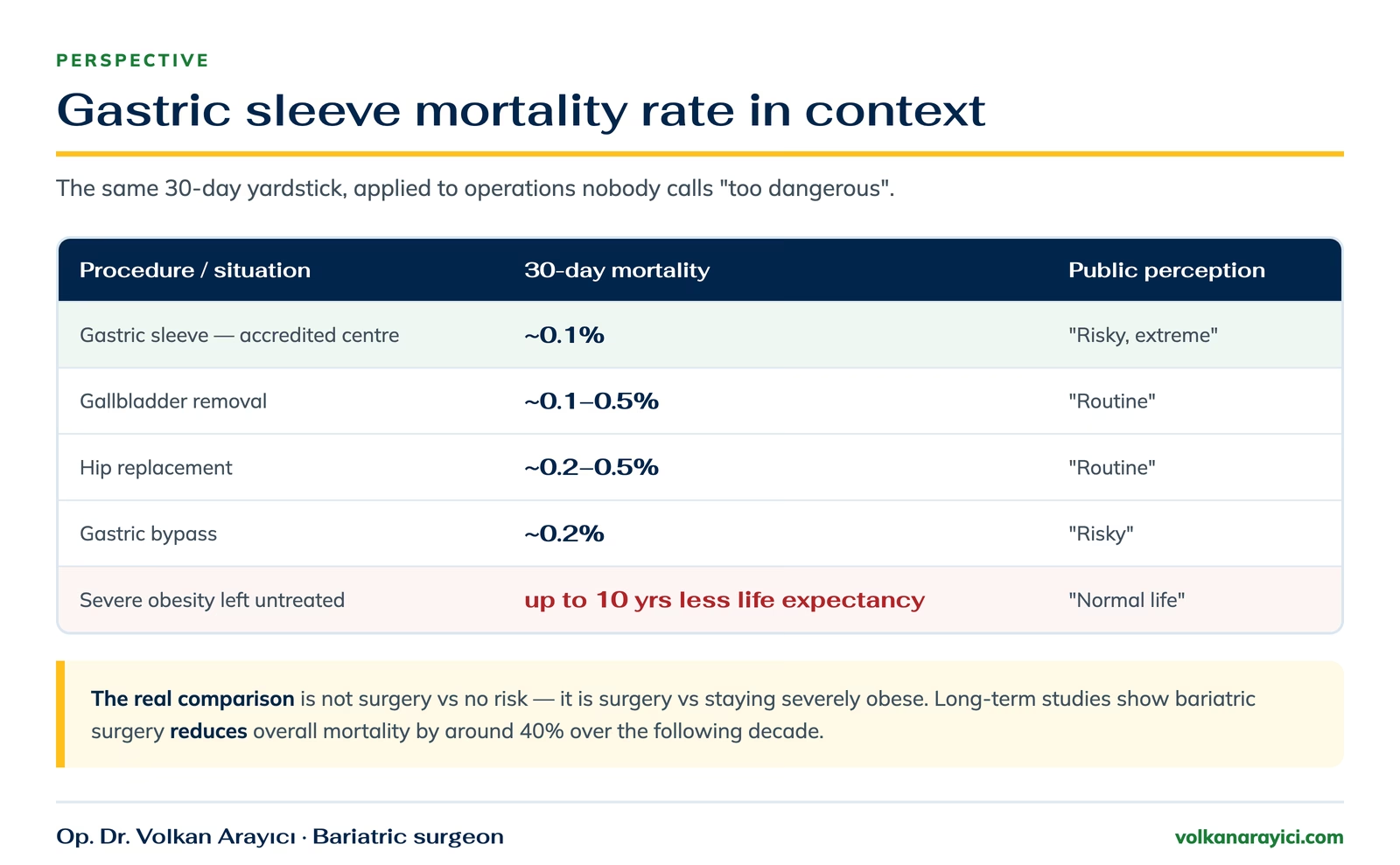
This is also where the statistic flips. Long-term studies following patients for a decade show that bariatric surgery reduces overall mortality by around 40% compared with matched patients who stay severely obese — fewer heart attacks, fewer diabetes complications, fewer obesity-related cancers. The mortality rate for weight loss surgery is a one-time, well-controlled 0.1%; the mortality rate of untreated severe obesity compounds every year. The fear points at the operating theatre; the statistics point at the sofa.
What actually goes wrong
The Top Causes of Death After Bariatric Surgery
When the rare fatal complication does occur, registry data shows it almost always comes from one of three mechanisms — and each one has a specific, well-established defence:
Staple-line leak
The most feared complication when detected late. Our defence: the staple line is oversewn with an inverting suture and tested for leaks during the operation itself — plus four nights of in-hospital monitoring, so early gastric sleeve leak symptoms are never watched from a hotel room.
Pulmonary embolism (blood clots)
A clot forming in the legs and travelling to the lungs. Our defence: anti-clotting injections, compression stockings and walking within hours of surgery — mobilisation starts the same day, not the next.
Cardiac events
Undiagnosed heart disease meeting the stress of anaesthesia. Our defence: every patient is cleared by cardiology, chest medicine and anaesthesiology before the operation is confirmed — surgery is postponed if anything needs treating first.
Who is actually at risk
Factors Increasing Mortality in Obesity Surgery
The averages hide a spread. The recognised factors increasing mortality in obesity surgery are a BMI above 55–60, age over 60–65, existing heart or lung disease, previous abdominal surgery — and, bigger than all patient factors combined, where and by whom the operation is performed. The first group you cannot change overnight; the second group you control completely with one decision.
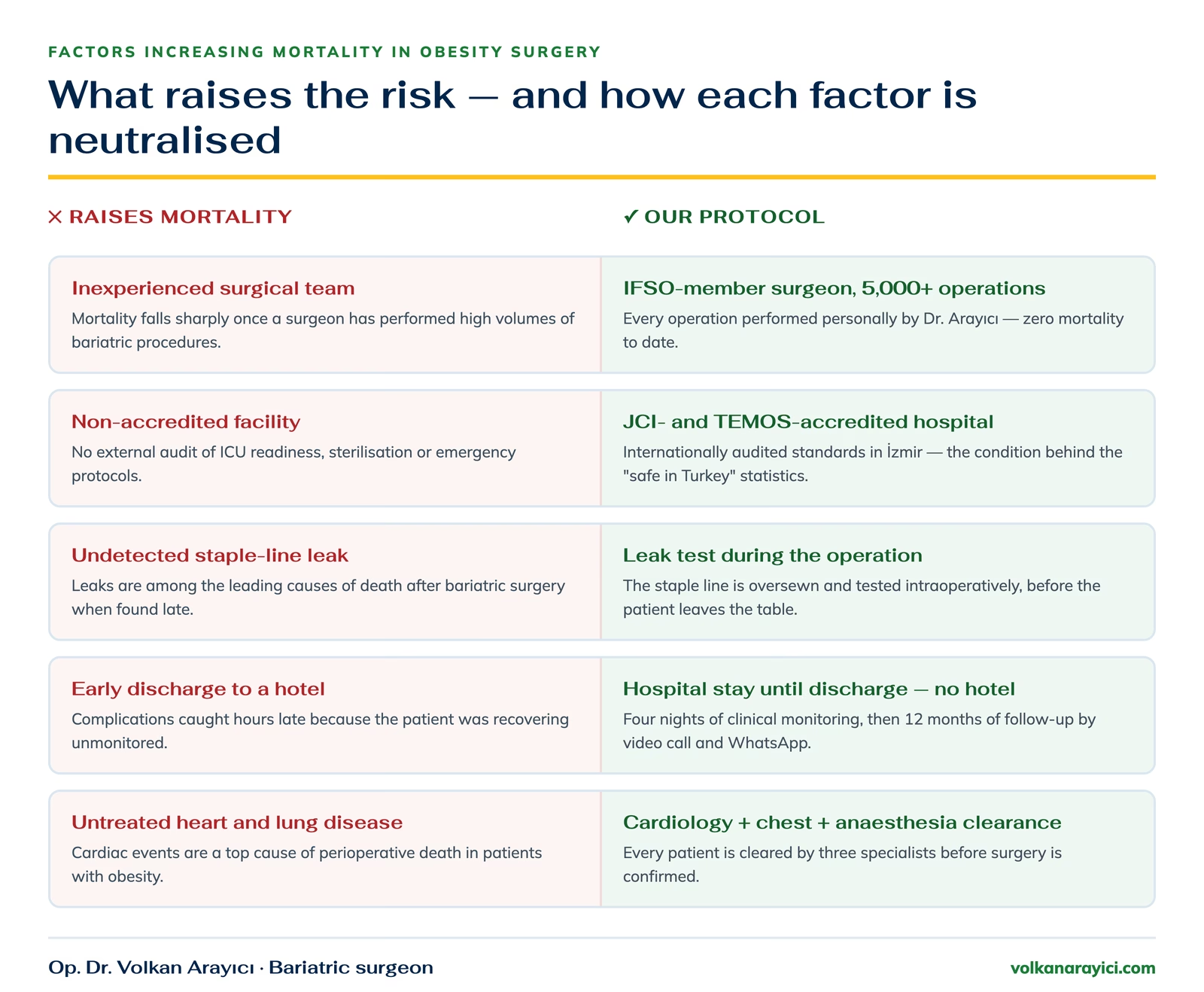
Note what is not on the patient side of that list: being "too heavy for surgery". A high BMI raises surgical risk, but it raises the risk of staying unoperated far more — which is why high-BMI patients benefit the most. What to look for in a clinic, question by question, is covered in our companion guide: how safe is gastric sleeve surgery in Turkey.
Our own record
Zero Mortality Across 5,000+ Procedures
Statistics describe populations; you will be operated on by one surgeon in one hospital. Op. Dr. Volkan Arayıcı, an IFSO-member bariatric surgeon, has performed more than 5,000 bariatric procedures — gastric sleeve surgery in Turkey, bypass and revision operations — with zero mortality to date. Operations take place at a JCI- and TEMOS-accredited hospital in İzmir, patients stay in hospital until discharge — no hotel transfer — and follow-up continues for 12 months by video call and WhatsApp. In five years of the current technique there has been no drain, no leak, and no death.
Numbers are one kind of evidence; people are another. You can hear how the process felt from UK and international patients in their own words on our gastric sleeve Turkey experiences page, or read about the surgeon's background on the about Dr. Volkan Arayıcı page.
Still weighing the risk? Send your questions — the surgeon answers personally, usually within hours.
WhatsApp: +90 532 466 67 67The numbers behind the headlines
How Many People Actually Die From Bariatric Surgery Each Year?
UK searches show this exact question, so let's answer it with arithmetic instead of headlines. Hundreds of thousands of bariatric operations are performed worldwide every year; at a bariatric surgery death rate of 0.1–0.2%, that means one to two fatalities per thousand operations — and several hundred thousand patients per year who go on to live longer, healthier lives. The media covers the individual tragedy, never the 999 uneventful recoveries around it; both are real, but only one of them shapes public perception. That asymmetry is worth remembering when a single news story feels like a statistic.
It is also why the gastric sleeve death rate Turkey headlines describe and the one its accredited hospitals record are two different numbers: press coverage clusters around unaudited budget clinics and hotel-based recovery — precisely the factors the previous section showed how to avoid.
Does age change the picture?
Yes, moderately. Mortality risk rises after about 60–65, mostly because heart and lung disease become more common — the operation itself does not change. In practice this means older patients are screened more strictly, not refused: with full cardiac clearance, patients in their sixties undergo sleeve surgery routinely and safely. Age on its own is a factor to plan around, never a verdict.
The takeaway
How to Read the Gastric Sleeve Death Rate as a Patient
Three habits keep the numbers honest. First, always ask which number you are looking at — 30-day mortality in accredited centres is the comparable yardstick; blended figures that mix audited and unaudited clinics tell you nothing about either. Second, translate percentages into people: 0.1% means 1 in 1,000 — a real risk, similar to everyday operations, and dramatically smaller than the compounding risk of untreated severe obesity. Third, remember that the gastric sleeve death rate Turkey achieves in its accredited hospitals is not luck; it is the visible output of specific, checkable inputs — accreditation, surgeon volume, intraoperative leak testing, in-hospital recovery and structured aftercare. Check the inputs, and the number takes care of itself.
Procedure comparison
Gastric Sleeve vs Gastric Bypass: The Mortality Numbers
Within the gastric sleeve death rate Turkey statistics, the sleeve is the lowest-risk of the major bariatric procedures because the operation removes stomach volume without rerouting the intestine. A gastric bypass surgery in Turkey carries a slightly higher 30-day figure — around 0.2% — reflecting the additional intestinal connections, and revision operations sit marginally above that again. All three remain far safer than they were a decade ago, and all three are performed under the same protocol and accreditation standards described above. If you are comparing procedures, mortality alone should not decide it: the right operation depends on your reflux status, BMI and metabolic profile — the topics we go through in a free weight loss surgery in Turkey consultation.
FAQ
Gastric Sleeve Death Rate Turkey — Frequently Asked Questions
What is the gastric sleeve death rate in Turkey?
The gastric sleeve death rate Turkey records in JCI- and TEMOS-accredited hospitals is approximately 0.1% within 30 days — about 1 in 1,000 patients. This is below the ~0.2% pooled global average and comparable with leading Western European and US centres.
Has anyone died from gastric sleeve surgery in Turkey?
Yes — individual cases reported in the UK media are real, and they deserve honesty rather than denial. Investigations of those cases consistently point to the same pattern: unaccredited facilities, hotel-based recovery and absent follow-up. The statistics for accredited hospitals with experienced surgical teams tell a different story — which is why checking accreditation is the single most protective step a patient can take.
What is the gastric sleeve death rate in 2026 — has it gone up?
No. The rate has been stable-to-improving for years; worldwide bariatric mortality has fallen roughly ten-fold since the early 2000s. Whether you look up the gastric sleeve Turkey death rate for 2022, 2023 or 2026, accredited-centre mortality remains around 0.1%.
What are the top causes of death after bariatric surgery?
Registry data points to three mechanisms: staple-line leaks detected late, pulmonary embolism (blood clots), and cardiac events in patients with undiagnosed heart disease. Each has a specific defence — intraoperative leak testing, early mobilisation with anti-clotting measures, and full cardiac clearance before surgery.
Is the gastric sleeve mortality rate higher than a bypass?
No — it is lower. The sleeve runs at roughly 0.1% versus about 0.2% for a bypass, because the sleeve does not create new intestinal connections. Both figures apply to experienced, accredited centres.
Is it safe to have a gastric sleeve in Turkey at all?
In an accredited hospital with an experienced IFSO-member surgeon, in-hospital recovery and structured aftercare — yes, with outcomes matching Western centres. The full decision checklist, red flags included, is in our guide to how safe gastric sleeve surgery in Turkey really is.
How many people die from bariatric surgery each year?
At a rate of 0.1–0.2%, roughly one to two patients per thousand operations — against hundreds of thousands of successful operations worldwide every year. Individual cases in the news are real, but they overwhelmingly trace back to unaccredited clinics and hotel-based recovery rather than to the operation itself.
What is the mortality rate for weight loss surgery overall?
Across all bariatric procedures in experienced centres, the mortality rate for weight loss surgery averages around 0.1–0.2% — comparable to gallbladder removal. Long-term, surgery is associated with about 40% lower overall mortality than remaining severely obese.
Op. Dr. Volkan Arayıcı
Specialist in Bariatric & Metabolic Surgery · Izmir, Turkey
This article was written and medically reviewed by Op. Dr. Volkan Arayıcı. Dr. Arayıcı has been exclusively specialising in bariatric surgery since 2014 and has performed over 5,000 procedures at a JCI- and TEMOS-accredited hospital in Izmir.
✍ Published: February 24, 2024 · 🔄 Updated: September 3, 2026 · About the author →
