
Aftercare guide · Honest answers
Alcohol After Gastric Sleeve Surgery: Complete Safety Guide
The rules for alcohol after gastric sleeve surgery are strict for reasons your body will explain the first time you ignore them: a drink now reaches your blood in under ten minutes and hits nearly twice as hard. This guide answers the question the way patients actually ask it — week by week, without preaching.

The short answer
The General Rule for Alcohol After Bariatric Surgery
The first rule of alcohol after gastric sleeve surgery: avoid it completely for at least six months — and ideally twelve. The same rule for alcohol after bariatric surgery of any type exists for three reasons: your staple line needs time to heal, your liver is already working overtime processing rapid weight loss, and your new anatomy absorbs alcohol so fast that your old sense of "just one drink" no longer protects you. After the waiting period, alcohol can return — occasionally, in small amounts, under new rules that apply for life.
That is the honest framing most patients never get: the question is not only when you can drink again, but how differently drinking works from now on. Both answers are below, along with what alcohol after weight loss surgery does to dumping, vitamins and — a risk worth taking seriously — dependency.
Week by week
When Can You Drink Alcohol After Gastric Sleeve Surgery? The Honest Timeline
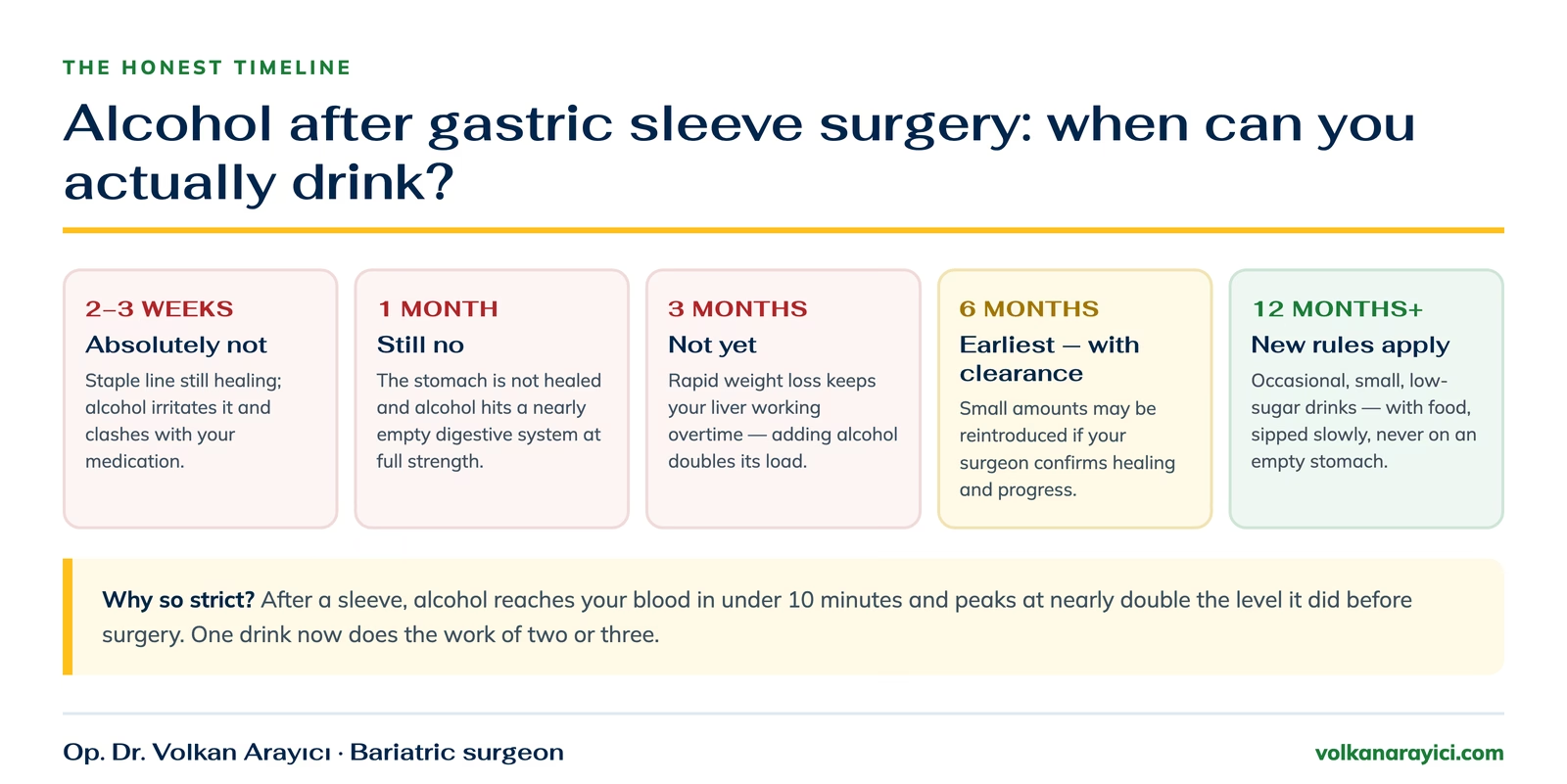
Patients count in weeks, so let's answer in weeks. UK searches for this page are full of "3 weeks after", "1 month after", "3 months after" — here is what each of those moments actually looks like inside your body:
Can I drink alcohol 3 weeks after gastric sleeve surgery?
No. At three weeks your staple line is still actively healing, you are on a soft-food diet and often still on medication that interacts with alcohol. A drink now irritates the healing stomach directly and risks genuine harm — this is the one stage where the answer has no nuance at all.
Can I drink alcohol 1 month after gastric sleeve surgery?
Still no — and this is the most-searched version of the question, so it deserves a straight answer. At one month the internal healing is simply not finished, your intake is tiny, and alcohol lands on a nearly empty digestive system at full strength. Patients who drink alcohol after gastric sleeve surgery this early describe being overwhelmed by half a glass — dizziness, nausea, a racing heart. Your body is telling you the truth: it is not ready.
What about 3 months after?
Better, but not yet. By three months your stomach has largely healed — the problem has moved to your liver, which is processing the fat released by rapid weight loss at maximum capacity. Alcohol adds a second full-time job on top. Most bariatric teams, ours included, hold the line at this stage precisely because patients feel fine and assume the risk has passed.
6 to 12 months: the reintroduction window
From six months, if healing and weight loss are on track and your surgeon confirms it, small amounts of alcohol can be reintroduced. Many patients — particularly after a bypass, or after any complication — are advised to wait the full twelve. From then on the lifetime rules apply: small, occasional, low-sugar, never on an empty stomach.
The new body math
Why Gastric Sleeve and Alcohol Are a Different Equation Now
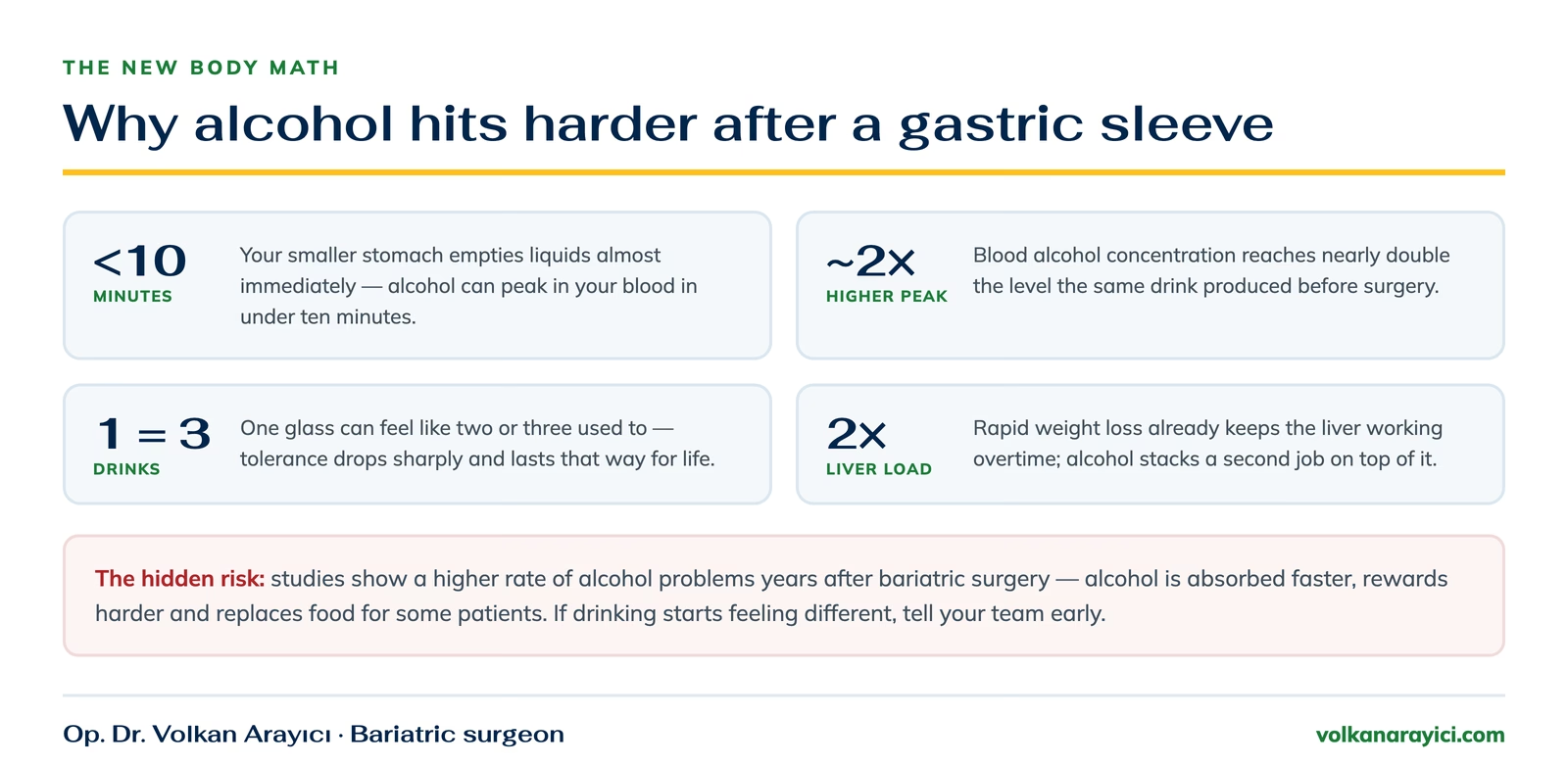
The gastric sleeve and alcohol relationship changes permanently, and the numbers explain why better than any warning. Your smaller stomach produces less of the enzyme that begins breaking alcohol down, and it empties liquids into the small intestine almost immediately — where absorption is fastest.
Signs of Alcohol Intoxication After Surgery: What to Watch For
Because the spike is so fast, the signs of alcohol intoxication after surgery arrive sooner and harder than patients expect: sudden dizziness or light-headedness after a few sips, flushing, a racing heart, nausea, slurred speech and unusually rapid drowsiness. Two practical consequences follow. First, never drive after any alcohol — you can be legally over the limit on a single small drink. Second, in social settings pace yourself against your new body, not against the table: sip, don't match rounds, and stop at the first warning sign. Knowing the signs of alcohol intoxication after surgery is not trivia — it is what keeps an evening out from becoming an emergency.
Social settings deserve their own strategy, because that is where most early mistakes happen. Order a still water alongside whatever you drink; hold a glass so nobody tops you up unasked; and decide your limit before the evening, not during it. Friends who knew you before surgery will pour for the old you — the person managing alcohol after gastric sleeve surgery well is the one who quietly pours for the new one.
Myth check
Three Myths About Alcohol After Weight Loss Surgery
"After a year, everything goes back to normal"
No. The waiting period ends; the new physiology doesn't. Faster absorption, higher peaks and lower tolerance are permanent features of your new anatomy — at year one, year five and year twenty.
"Wine is basically harmless"
A small dry wine is the least bad option, which is not the same as harmless. It still carries empty calories, still spikes faster than before, and sweet wines add the sugar that triggers dumping.
"Alcohol calories don't count because I eat so little"
They count double. Alcohol delivers calories with zero nutrition while your tiny intake budget desperately needs protein and vitamins — and it lowers inhibitions around exactly the foods you are trying to avoid. Drinking regularly is one of the quiet paths to weight regain.
The weight-regain link deserves one more sentence, because it is the myth patients pay for years later: a nightly glass of wine adds roughly 40,000 empty calories a year — more than five kilograms of body weight — invisible in any single evening and unmistakable on the scale by the second anniversary. The same maths applies to gastric bypass and alcohol, where the calories arrive even faster. Alcohol after gastric sleeve surgery is not forbidden forever; alcohol as a habit is what the operation cannot survive.
Two risks patients don't expect
Dumping Syndrome, Vitamins and the Drinks That Trigger Both
Sugary alcohol — cocktails, liqueurs, alcopops, sweet wine — can set off dumping syndrome: cramping, sweating, a pounding heart and diarrhoea after gastric sleeve surgery within half an hour of drinking. If a drink ever makes you feel suddenly, dramatically unwell, dumping is the likely explanation — and the sugar content, not the alcohol itself, is usually the trigger.
The quieter cost is nutritional. Alcohol interferes with the absorption of exactly the vitamins bariatric patients must guard — B1, B12, folate — and irritates a stomach that can also react with nausea after gastric sleeve surgery. It is also a diuretic, which matters when your water consumption after gastric sleeve surgery is already limited by the smaller stomach: alternate every alcoholic drink with water, and never arrive at a drink already dehydrated.
The serious one
Alcohol Dependency After Bariatric Surgery: A Real, Measured Risk
This deserves plain language because research backs it: the rate of alcohol dependency after bariatric surgery is measurably higher than in the general population, particularly from the second year onwards. The mechanics stack the deck — alcohol is absorbed faster and rewards harder, food no longer works as an emotional outlet, and "transfer addiction" can quietly move the old coping habit from eating to drinking.
What we tell our own patients: if drinking starts feeling different — more frequent, more necessary, more private — that is a medical signal, not a personal failure. Raise it at any 12-month follow-up call or message us directly; addressing alcohol dependency after bariatric surgery early is straightforward, and hiding it is the only real mistake. Patients with a history of alcohol problems should discuss this openly before surgery — for some, the bypass's stronger absorption effect argues for the sleeve instead.
The practical list
Which Drinks Are Safer — and Which to Skip for Good
Once your surgeon clears you to drink alcohol after gastric sleeve surgery, the choice of drink matters as much as the amount:
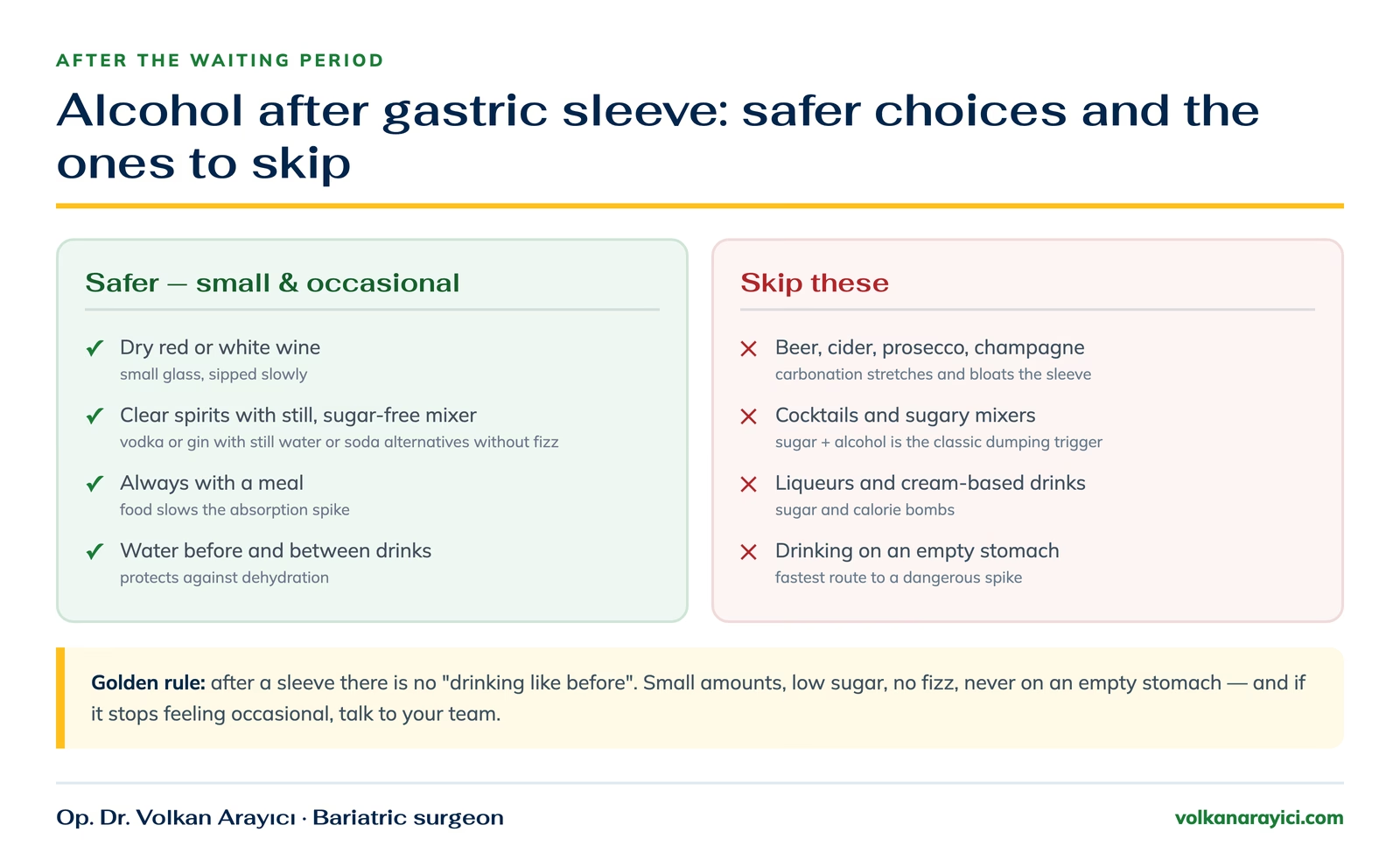
The two dividing lines are simple. Carbonation — beer, cider, prosecco, champagne — stretches and bloats the sleeve, which is why fizzy drinks of any kind leave the menu permanently. Sugar — cocktails, liqueurs, sweet mixers — is the dumping trigger and the calorie bomb. What remains: an occasional small dry wine, or a clear spirit with a still, sugar-free mixer, always alongside food, always sipped slowly.
Sleeve vs bypass
Alcohol After Gastric Bypass: Why the Rules Are Even Stricter
Everything on this page applies to alcohol after gastric bypass surgery — amplified. The bypass reroutes food past the stomach section that begins alcohol breakdown, so absorption is even faster and blood alcohol climbs even higher than after a sleeve. The gastric bypass and alcohol combination also carries the higher documented dependency risk, and dumping is more frequent because sugars reach the intestine directly. In practice: gastric bypass surgery patients are routinely advised to wait the full 12 months, and some teams recommend keeping alcohol after gastric bypass to rare, symbolic amounts for life — a toast, not an evening.
Before surgery, too: stop drinking at least two days (48 hours) before any bariatric operation — alcohol interferes with anaesthesia, clotting and liver function exactly when your body needs all three at their best. Longer abstinence before surgery is even better for the liver, and for patients drinking regularly, we discuss it openly at the pre-operative assessment.
Who is answering
Advice From the Team That Follows You for 12 Months
This guide was written by Op. Dr. Volkan Arayıcı, IFSO-member bariatric surgeon with more than 5,000 operations — gastric sleeve surgery in Turkey, bypass and revision — performed at a JCI- and TEMOS-accredited hospital in İzmir. Questions about alcohol come up constantly in our 12-month follow-up by video call and WhatsApp, and honest answers beat comfortable ones: alcohol is one of the permanent trade-offs listed openly on our disadvantages of gastric sleeve page. If you are still researching weight loss surgery in Turkey, ask us the awkward questions before the operation — that is what the consultation is for. More about the surgeon on the about Dr. Volkan Arayıcı page.
Unsure whether your timeline, medication or history changes the rules for you? Ask — the surgeon answers personally.
WhatsApp: +90 532 466 67 67FAQ
Alcohol After Gastric Sleeve — Frequently Asked Questions
When can you drink alcohol after gastric sleeve or bypass surgery?
The safe window for alcohol after gastric sleeve surgery opens at six months at the earliest, and ideally twelve — bypass patients are usually advised the full year. Your surgeon confirms the exact timing based on your healing and progress. After that, alcohol returns only in small, occasional, low-sugar amounts.
Can I drink alcohol 1 month after gastric sleeve surgery?
No. One month is far too early for alcohol after gastric sleeve surgery: the staple line is still healing and a drink hits a nearly empty digestive system at close to double the old strength. Wait for your surgeon's clearance — six months at the earliest.
Can you ever drink normally again after a gastric sleeve?
Honestly: no — not "normally" as before. The waiting period ends, but faster absorption, higher peaks and lower tolerance are permanent. Most patients settle happily into an occasional small drink under the new rules; drinking like before surgery is the one option that no longer exists.
What are the signs of alcohol intoxication after surgery?
Sudden dizziness after a few sips, flushing, racing heart, nausea, slurred speech and rapid drowsiness — arriving much faster than before surgery. Stop at the first sign, and never drive after any alcohol: a single drink can put you over the legal limit.
Why is alcohol after gastric bypass even more restricted?
The bypass skips the stomach section where alcohol breakdown begins, so absorption is faster and peaks higher than after a sleeve, dumping is more frequent, and the documented dependency risk is greater. Most bypass patients wait 12 months and keep alcohol rare permanently.
Is there a higher risk of alcohol dependency after bariatric surgery?
Yes — research shows a measurably higher rate, especially from the second year, driven by faster absorption and "transfer addiction". If drinking starts feeling more frequent or necessary, tell your team early; it is a recognised medical issue with straightforward help.
Can drinking alcohol after gastric sleeve surgery cause dumping syndrome?
Yes — sugary drinks are a classic trigger. Cocktails, liqueurs and sweet wines can cause cramping, sweating, a pounding heart and diarrhoea within about 30 minutes. Choosing dry, low-sugar drinks avoids most episodes.
When should I stop drinking alcohol before bariatric surgery?
At least 48 hours before the operation — alcohol affects anaesthesia, blood clotting and liver function. Longer is better for the liver; if you drink regularly, tell your surgical team so the pre-operative plan accounts for it.
Op. Dr. Volkan Arayıcı
Specialist in Bariatric & Metabolic Surgery · Izmir, Turkey
This article was written and medically reviewed by Op. Dr. Volkan Arayıcı. Dr. Arayıcı has been exclusively specialising in bariatric surgery since 2014 and has performed over 5,000 procedures at a JCI- and TEMOS-accredited hospital in Izmir.
✍ Published: December 23, 2023 · 🔄 Updated: September 3, 2026 · About the author →
