
Patient guide · neutral · free to print
Weight loss surgery abroad: a UK checklist before you book, and aftercare with your GP
Thinking about weight loss surgery abroad, or just back from an operation? This page answers the concerns raised by BOMSS and the NHS point by point: what to check before you pay, which documents to bring home and how your GP can take over aftercare – whichever clinic you choose.
Medically reviewed by Op. Dr. Volkan Arayıcı, bariatric surgeon · updated November 2026. This page does not replace advice from your own doctor.
Weight loss surgery abroad: the operation is one day, aftercare is months
Weight loss surgery abroad takes 45 to 90 minutes in theatre. Aftercare takes months – and it almost always happens at home, with an NHS GP, a practice nurse or an A&E team who did not do the operation. UK doctors have described how often patients come back without an operation note, a medication plan or a follow-up schedule (Medical Protection: treatment abroad and GP follow-up).
Whether weight loss surgery abroad goes well is therefore decided before you book: who operates, how many nights you stay in hospital, who is responsible if something goes wrong and what your GP will have in hand. This checklist is written to work for any clinic – in Turkey, elsewhere in Europe or in the UK. We are a Turkish surgical practice ourselves; where we describe our own approach, we say so.
BOMSS and NHS concerns about weight loss surgery abroad, answered point by point
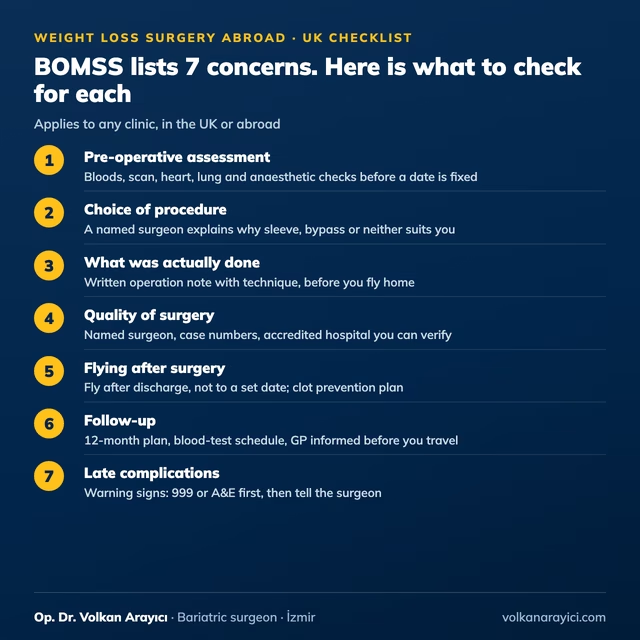
The British Obesity & Metabolic Specialist Society (BOMSS) advises UK residents to be cautious about bariatric surgery abroad and lists seven specific concerns (BOMSS statement on going abroad for weight loss surgery). We think they are fair. Here is what to check for each one, whichever clinic you are considering.
| BOMSS concern | What to check before you book |
|---|---|
| 1 · Lack of expert pre-operative assessment | Blood tests, abdominal ultrasound, heart, lung and anaesthetic review are done in person before surgery – and the clinic says in writing that surgery can be postponed or cancelled if results are abnormal. |
| 2 · Poor choice of procedure | The surgeon, not a sales adviser, explains why a sleeve, a bypass or no operation suits you, based on your BMI, reflux, diabetes and medication. |
| 3 · A different procedure, or details unknown | You receive a written operation note before you fly: procedure, technique (bougie size, limb lengths), surgeon’s name. The same name appears on the consent form. |
| 4 · Unknown quality and safety | A named surgeon with verifiable training and case numbers, operating in a hospital (not a day clinic) with intensive care, whose accreditation you can find on the accreditor’s own website. |
| 5 · Long-distance travel straight after surgery | The flight follows discharge, not the other way round. You get blood-thinning injections, compression stockings and clear advice for the journey. |
| 6 · Poor access to routine follow-up | A written follow-up plan for at least 12 months, a blood-test schedule your GP can use, and a named doctor you can reach. |
| 7 · No direct expert care for late complications | You know the red-flag symptoms, you go to A&E first, and the surgeon stays available to advise the UK team. Your GP is told before you travel. |
The NHS also points travellers to the medical tourism factsheet from TravelHealthPro, and GPs can find background on the BOMSS GP Hub.
Gastric sleeve abroad checklist: 24 points before you book
Tick only what the clinic has confirmed in writing. Promises on the phone or in a chat do not count. If more than two or three points of this gastric sleeve abroad checklist stay open for your weight loss surgery abroad, ask again – or keep looking. The same points apply to a bypass.
A · Surgeon and qualifications
B · Hospital and length of stay
C · Complications and contract
D · Preparation
E · Going home and aftercare
Hospital or hotel: why the nights after surgery matter
Many package deals for weight loss surgery abroad move patients to a hotel one or two days after the operation. That lowers the price – but it moves monitoring out of hospital at exactly the time when complications usually show.
Bleeding, staple-line leaks and blood clots often show between day one and day five – first in pulse, temperature and pain.
Nurses check vital signs regularly, bloods and scans are on site, and the surgeon does the ward round. Deterioration is noticed early.
You have to notice yourself that something is wrong and organise the way back – often at night and with a language barrier.
So do not just ask “How many days?”, ask “How many nights in hospital, and who decides when I am discharged?”. How this works in practice is described on our page about gastric sleeve Turkey with a hospital stay until discharge.
12 questions to ask any clinic – and what a good answer looks like
Ask these questions to every clinic you are considering for weight loss surgery abroad – ideally by email, so you can compare the answers side by side.
| Question | A reliable answer … |
|---|---|
| Who will operate on me? | gives a name and specialist title. The same name appears later on the operation note. |
| How often do they do this operation? | gives a number per year and says whether they also do revision surgery. |
| Can I speak to the surgeon first? | offers a consultation with the doctor, not only with a coordinator. |
| Which pre-op tests are done? | describes bloods, ultrasound, heart, lung and anaesthetic review – and that surgery can be postponed if results are abnormal. |
| How many nights will I stay in hospital? | gives a number and says clearly whether a hotel is part of the plan. |
| What happens if there is a complication there? | describes treatment in the same hospital and puts the costs in writing. |
| And after I am home? | names a doctor you can reach, provides documents for your GP and, if needed, a return visit. |
| What is included in the price – and what is not? | comes as a list, including medication, interpreter, transfers and follow-up. |
| Will I get an operation note and discharge summary? | says yes, in English, before you leave. |
| How long do you follow me up? | names months, a channel and a blood-test plan. |
| When can I fly? | ties the flight to discharge, not the other way round, and explains clot prevention. |
| Who would you advise against surgery? | shows there are reasons to say no – a clinic that operates on everyone is not assessing. |
Warning signs in offers for weight loss surgery abroad
- A surgery date within days, without anyone asking about your health or medication.
- A discount only if you book now, or a deposit before you have spoken to a doctor.
- No surgeon’s name, only “our team”.
- Transfer to a hotel on the first or second day after surgery.
- Promises such as “risk-free” or a fixed number of kilos.
More criteria for choosing a clinic are on our page about the best gastric sleeve clinic in Turkey; honest figures on risk are in the article how safe is gastric sleeve surgery in Turkey.
A question about the checklist
Not sure about an offer?
Tell us what you have been offered. Op. Dr. Volkan Arayıcı will tell you honestly which points are still open – even if you have surgery somewhere else.
Prefer WhatsApp? +90 532 466 67 67
The documents that belong in your hand luggage
After weight loss surgery abroad, your documents are the only thing your GP and an A&E team in the UK know about the operation. Get everything before discharge, on paper and as a photo or PDF on your phone.
Procedure, date, surgeon, technical details (e.g. bougie size for a sleeve, limb lengths for a bypass), anything unusual.
Course in hospital, complications yes/no, findings at discharge, recommendations for further care.
Blood thinners, stomach protection, vitamins and minerals – with dose and duration. Changes to your regular medication.
Blood results before and after surgery, ultrasound, echocardiogram and, if taken, histology of the removed tissue (often comes later).
Stages from liquids to purée to soft and normal food, with weeks for each. Your fluid target too – see water consumption after gastric sleeve.
Surgeon’s name and phone number, when they can be reached, which language. Save it in your phone under “ICE” as well.
GP letter template after weight loss surgery abroad
Print this template and ask your clinic to complete it before discharge, in English. Your GP then gets the key facts on one page, even if the full operation note is longer or in another format.
Information for the patient’s GP
Dear Doctor, your patient has had bariatric surgery with us. We would be grateful if you could support their aftercare according to the plan below.
If fever, a pulse persistently above 120/min, increasing abdominal pain, breathlessness or vomiting blood: assess in the nearest emergency department and inform the surgeon in parallel.
GP practices differ in what they offer after privately funded surgery; some publish a policy that specialist bariatric follow-up is not provided at the practice. Most GPs will still help with clinical problems, wound checks and blood tests if they are told in advance and get clear information. Speak to your practice before you travel, not only when you have symptoms – aftercare after surgery abroad works best when it is planned before the operation.
Aftercare after weight loss surgery abroad: blood tests and vitamins
Medically, aftercare after weight loss surgery abroad is the same as after surgery in the UK. The difference: you have to organise it yourself. The UK framework is set out in NICE guidance on overweight and obesity management (NICE NG246), including follow-up after bariatric surgery.
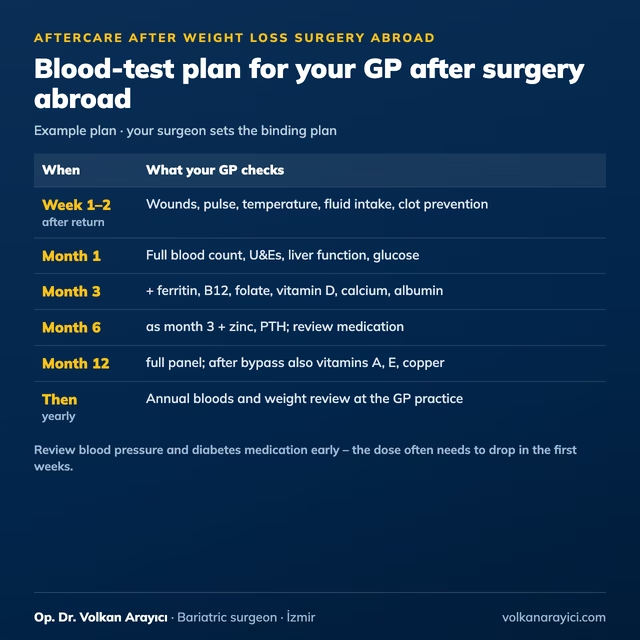
| When | What your GP checks | Why |
|---|---|---|
| Week 1–2 | Wounds, pulse, temperature, fluid intake, clot prevention | Spot early complications and dehydration |
| Month 1 | Full blood count, U&Es, liver function, glucose | Adjust blood pressure and diabetes medication |
| Month 3 | + ferritin, vitamin B12, folate, vitamin D, calcium, albumin | Deficiencies show before symptoms do |
| Month 6 | as month 3, plus zinc and PTH | Hair loss and bone metabolism |
| Month 12 | full panel; after a bypass also vitamins A, E and copper | A bypass changes absorption more |
| Then yearly | Blood tests, weight, medication review | See late deficiencies and weight regain early |
Vitamins: which supplements you take and for how long is set by your surgeon and adjusted to your blood results – usually longer after a bypass than after a sleeve. Do not stop anything on your own. Noticeable hair shedding between months three and six is common and usually temporary; background in hair loss after gastric sleeve surgery.
Fluids: in the first weeks, not drinking enough is the most common reason patients need to be seen again. Small sips, all day, from the first day home.
Red flags after you are home: when to call 999 or go to A&E
After weight loss surgery abroad, the clinic is far away. With these signs: A&E or 999 first, then tell the clinic – not the other way round. Take your operation note and say straight away which operation you had. For urgent advice that is not an emergency, call NHS 111.
| Sign | Possible cause | What to do |
|---|---|---|
| Pulse persistently above 120/min, fever, increasing abdominal pain, pain in the left shoulder | Staple-line leak, infection | A&E now |
| Breathlessness, chest pain, coughing blood | Pulmonary embolism | 999 |
| Vomiting blood, black tarry stools, dizziness | Bleeding | 999 |
| Swollen, painful calf on one side | Deep vein thrombosis | Same day: GP, NHS 111 or A&E |
| Hardly any fluids for over 24 hours, dark urine, weakness | Dehydration, narrowing | Same day, a drip may be needed |
| Repeated vomiting with confusion, double vision or unsteady walking | Vitamin B1 (thiamine) deficiency | A&E, mention the operation |
| Redness, warmth or pus at a wound | Wound infection | GP within 24 hours |
| Colicky pain upper right, yellow skin (often months later) | Gallstones | GP; with fever, A&E |
| Severe tiredness, tingling in hands or feet | Iron, B12 or other deficiency | Blood tests with your GP |
How a leak may show itself is explained in gastric sleeve leak symptoms.
Who pays if something goes wrong after surgery abroad?
The NHS does not fund planned private surgery abroad. If you are acutely unwell after weight loss surgery abroad, A&E will treat you; specialist bariatric follow-up of privately funded surgery is not routinely provided, so arrange your plan in advance.
It usually covers unexpected illness on a trip. Planned surgery and its consequences are excluded by many policies – read the terms. The FCDO also has health advice for travel to Turkey.
Some clinics offer it. Check the period, the maximum amount and whether it covers treatment in the UK or only a return to the clinic.
What a package typically includes and what it does not is listed on our page about gastric sleeve surgery price in Turkey.
Transparent example · our answers
40 questions to ask the clinic – and how we answer them
Ask every clinic these questions before weight loss surgery abroad. Below are our own answers – to compare with other offers, not as a benchmark. Updated 12 November 2026, medically reviewed by Op. Dr. Volkan Arayıcı.
Weight loss surgery abroad with Op. Dr. Volkan Arayıcı – at a glance
- Surgeon: Op. Dr. Volkan Arayıcı in person, IFSO member, more than 5,000 operations, about 250 a year.
- Hospital: JCI- and TEMOS-accredited, İzmir, own intensive care unit; four nights until discharge, no hotel.
- Serious complications: about 2 in 1,000 operations in our own series.
- Reachable: Dr. Arayıcı around the clock on +90 532 466 67 67 (WhatsApp or phone).
- Price: gastric sleeve from £3,000, gastric bypass from £3,500, all inclusive except flights; no deposit, free cancellation.
- Aftercare: twelve months by WhatsApp and video call, blood tests at 1, 3 and 6 months.
1 · Suitability: is weight loss surgery abroad right for me?
- 1. Do I really need surgery with my BMI?
- Dr. Arayıcı decides from your details. Surgery is usually considered from BMI 35, or from BMI 30 with a weight-related condition such as type 2 diabetes. From BMI 27 a gastric balloon may be an option.
- 2. Why a gastric sleeve and not a bypass?
- With significant reflux a bypass is usually the better choice, because a sleeve can make reflux worse. The comparison is on gastric sleeve vs gastric bypass.
- 3. Who do you not operate on?
- We do not operate below BMI 30. And without clearance from cardiology, the lung specialists and anaesthesia, there is no operation.
- 4. What do I give up in the long term?
- A gastric sleeve cannot be reversed. Reflux can appear or get worse, you take vitamins for about nine months, and without changing how you eat, weight can come back.
2 · Surgeon: who operates on bariatric surgery abroad?
- 5. Who will operate on me – by name?
- For your surgery abroad: Op. Dr. Volkan Arayıcı, consultant general surgeon. He operates on every patient himself.
- 6. How often do you perform this operation?
- More than 5,000 bariatric operations since 2014, currently about 250 a year.
- 7. Can I speak to the surgeon directly before surgery?
- Yes – before any weight loss surgery abroad you should insist on it. Dr. Arayıcı speaks English, so you talk to him directly.
- 8. Which professional bodies are you a member of?
- Dr. Arayıcı is a member of IFSO, the international federation for obesity and metabolic surgery.
3 · Hospital and day of surgery
- 9. Which hospital do you operate in?
- For bariatric surgery abroad we use a JCI- and TEMOS-accredited hospital in İzmir with its own intensive care unit.
- 10. Is there intensive care and round-the-clock cover?
- Yes: intensive care in the building, nursing around the clock and a daily ward round by the operating surgeon.
- 11. Does the anaesthetist see me before surgery?
- Yes. On the morning of surgery you are examined by cardiology, the lung specialists and anaesthesia.
- 12. What happens if the pre-operative tests show a problem?
- Then there is no operation. You pay only for the tests, one day in hospital and the transfer – about €600 in total.
- 13. Will I be operated on the day I arrive?
- No. On arrival day only blood is taken; the other tests follow the next morning and the operation around midday.
4 · Technique
- 14. Which staplers do you use?
- Staplers made by Ethicon.
- 15. Is the staple line reinforced and tested?
- Yes – ask this before any weight loss surgery abroad. The staple line is oversewn in every operation and tested for leaks during the operation itself.
- 16. What do you do to prevent blood clots?
- Anti-clotting injections, compression stockings and getting up as early as two hours after surgery.
5 · Complications after weight loss surgery abroad
- 17. What is your own rate of serious complications?
- About 2 in 1,000 operations in our own series.
- 18. How common are leaks, bleeding and wound infection – and when do they appear?
- Leaks and bleeding are rare and usually show in the first days; that is why you stay four nights in hospital. Superficial wound infections: about 3%, usually minor.
- 19. Who treats a complication during my stay – and who pays for extra days?
- Treatment happens in the same hospital. Extra days, intensive care and medicines are included in the price – you pay nothing more.
- 20. Who do I contact if something is wrong after I get home?
- Dr. Arayıcı in person, around the clock on +90 532 466 67 67 (WhatsApp or phone). With warning signs, go to A&E and show your discharge report.
- 21. Who pays for a repeat operation – including travel?
- If a complication of the operation needs another procedure, we carry it out in İzmir at no extra cost. You pay the flight.
- 22. Do you have professional indemnity insurance?
- Yes.
6 · Costs of bariatric surgery abroad
- 23. What is included in the price?
- For weight loss surgery abroad with us: tests, the operation, four nights in hospital, medicines, transfers, accommodation and meals for one companion and twelve months of aftercare. Flights are not included. Gastric sleeve from £3,000, gastric bypass from £3,500.
- 24. When does it cost more than the quoted price?
- For high-risk patients, for example with serious other conditions, and above BMI 45 there is a surcharge. We tell you before you book your flight.
- 25. Is there a deposit – and what does cancelling cost?
- There is no deposit; you pay in cash on the day of surgery. If you cancel beforehand, there is no charge.
- 26. Does the NHS cover problems after surgery abroad?
- After weight loss surgery abroad, emergency care at home is provided through the NHS. Treatment of a complication in İzmir is covered by us.
- 27. Can I pay in instalments or with finance?
- No. There is no finance and no instalment plan.
7 · Stay and travel home
- 28. How many nights do I stay in hospital – and do I move to a hotel afterwards?
- Four nights in hospital until discharge. A hotel is not part of the plan.
- 29. Does the surgeon examine me before discharge?
- Yes. Dr. Arayıcı does a ward round every day, with a final check on day five.
- 30. When can I fly home after surgery abroad?
- On the day of discharge: on day five the transfer takes you straight from the hospital to the airport.
- 31. Is someone who speaks my language available at night?
- Yes. Dr. Arayıcı speaks English and is reachable around the clock, including at night.
- 32. Can a companion come – and what does it cost?
- Yes. A companion pays only their own flight; accommodation, transfers and three meals a day are included in the surgery price.
8 · Aftercare after surgery abroad
- 33. How long am I followed up – and who answers me?
- Aftercare after surgery abroad lasts twelve months by WhatsApp and video call; Dr. Arayıcı answers your questions.
- 34. When should I have blood tests?
- As part of aftercare after surgery abroad: at 1, 3 and 6 months. Send us the results and we go through them with you.
- 35. Will I get a report in my language?
- Yes. At discharge you receive the operation report and the discharge report, which works as the GP letter for your doctor after weight loss surgery abroad.
- 36. Is there a written plan for diet and vitamins?
- Yes. You get the diet plan in writing – liquids, purée, then solid food; you take vitamins for about nine months. The stages are set out above in the aftercare section.
- 37. What do you advise if I regain weight?
- First find the cause, then talk about a second operation. More on weight regain after gastric sleeve.
9 · Gastric sleeve abroad checklist: check reviews and real images
- 38. Can I talk to patients from the UK?
- Our operated patients can join a shared WhatsApp group if they wish. Stories with names and video are on patient stories from İzmir.
- 39. Where can I find independent reviews?
- Google 4.9 out of 5 (82 reviews), Trustpilot 4.8 (176) and ProvenExpert 5.0 (7) – each with name and date.
- 40. Are there real pictures from the hospital?
- Yes: videos of ward rounds and discharge, and photos with patients in their rooms.
Test case: three weeks after weight loss surgery abroad you develop a fever at night at home. What happens?
- With warning signs such as fever with abdominal pain, breathlessness or a fast pulse, call 999 or go to A&E straight away and take your discharge report with you.
- At the same time, message or call Dr. Arayıcı on +90 532 466 67 67, around the clock.
- Send us the findings; Dr. Arayıcı discusses the next steps with you. If a complication of the operation needs treatment in İzmir, it is done at no extra cost – you pay only the flight.
Frequently asked questions about weight loss surgery abroad
What should I check before weight loss surgery abroad?
Five things above all: who operates on you and how experienced they are, how many nights you stay in hospital, who treats and pays for complications, which documents you take home and how aftercare is organised with your GP. Get everything confirmed in writing.
Does BOMSS advise against weight loss surgery abroad?
BOMSS advises UK residents to be cautious and lists seven concerns: pre-operative assessment, choice of procedure, unknown details of the operation, quality of surgery, travel soon after surgery, follow-up and access to care for late complications. Each one can be checked before you book.
Will my GP provide aftercare after surgery abroad?
Practices differ. Most GPs help with clinical problems, wound checks and blood tests if they are told before you travel and get clear documents: operation note, discharge summary, medication and blood-test plan. Specialist bariatric follow-up is not routinely provided, and emergencies are always treated in A&E.
Which documents do I need when I come home?
An operation note, a discharge summary, a medication plan with durations, blood results and other findings, a diet plan and the surgeon’s contact details – in English, on paper and as a PDF or photo.
When should I call 999 or go to A&E after surgery abroad?
With a pulse persistently above 120 per minute, fever, increasing abdominal pain, breathlessness or chest pain, vomiting blood or black stools, or if you have hardly been able to drink for over 24 hours. Go to A&E first and tell your clinic afterwards. For non-emergency advice, call NHS 111.
Will the NHS treat complications after weight loss surgery abroad?
Emergencies are treated in A&E. The NHS does not fund the planned private operation, and specialist follow-up of privately funded surgery is not routinely provided. Check travel insurance terms and any complication cover before you go.
How many nights should I stay in hospital after surgery?
Until you drink enough, are mobile with controlled pain, and your pulse, temperature and blood results are stable – decided on a doctor’s ward round. Ask every clinic how many nights you spend in hospital and whether a hotel is planned afterwards.
Which blood tests are needed after weight loss surgery?
Full blood count, ferritin, vitamin B12, folate, vitamin D, calcium, PTH, albumin, zinc, kidney and liver function; after a bypass also vitamins A, E and copper. Checks at 1, 3, 6 and 12 months are usual, then once a year.
When can I fly home after surgery?
Once you have been discharged, drink enough and move about safely. The flight should follow discharge, not the other way round. On the flight: blood-thinning injections as prescribed, compression stockings, get up regularly and take small sips.
Written answer
Questions about aftercare or an offer?
Write to us using the form. You will get a personal reply from Op. Dr. Volkan Arayıcı, usually within 24 hours.
Or directly on WhatsApp: +90 532 466 67 67
Sources and further information
- BOMSS – British Obesity & Metabolic Specialist Society: Statement on going abroad for weight loss surgery (2023) and GP Hub.
- NICE: Overweight and obesity management, guideline NG246.
- Medical Protection: Treatment abroad – bariatric surgery and GP follow-up care.
- TravelHealthPro (NaTHNaC): Medical tourism – travelling for treatment.
- IFSO – International Federation for the Surgery of Obesity and Metabolic Disorders, member directory.
You are welcome to link to this weight loss surgery abroad checklist, print it and share it with patients.
Op. Dr. Volkan Arayıcı
Specialist in Bariatric & Metabolic Surgery · Izmir, Turkey
This article was written and medically reviewed by Op. Dr. Volkan Arayıcı. Dr. Arayıcı has been exclusively specialising in bariatric surgery since 2014 and has performed over 5,000 procedures at a JCI- and TEMOS-accredited hospital in Izmir.
✍ Published: October 28, 2026 · 🔄 Updated: November 12, 2026 · About the author →
